
-
Room 501, Building B, No. 666 Lugu Avenue, Yuelu District, Changsha City, Hunan Province, 410205, China

Wire Saw Safety: Seven Rules Every Operator Must Follow on Real Job Sites
Wire sawing is powerful and fast — and unforgiving of mistakes. Seven field-proven safety rules every operator should follow before starting any cut.
Wire Saw Safety: Seven Rules Every Operator Must Follow on Real Job Sites
A wire saw runs at high line speed with enormous tension — done right, it is the fastest way to cut reinforced concrete on bridge decks, high-rise retrofits, and underwater pier demolition. Done wrong, it is dangerous. These seven rules are the non-negotiables we teach every operator who buys a Kowis wire saw machine, and they reflect what is actually enforced on real construction sites in Europe, North America, and the Middle East.
1. Inspect the Diamond Wire Before Every Cut
Inspect the diamond wire saw rope before every cut for broken beads, damaged steel core, kinks, and uneven wear. A damaged diamond wire can snap at speed and cause injury or downtime. Inspect every loop before threading, and replace any questionable section. Electroplated diamond wire is more sensitive to kinks; sintered diamond wire tolerates more handling but still needs visual inspection. On bridge demolition and underwater cutting jobs, this step is mandatory and usually logged in the daily site report.
2. Guard the Cutting Area and Keep Watchers Out
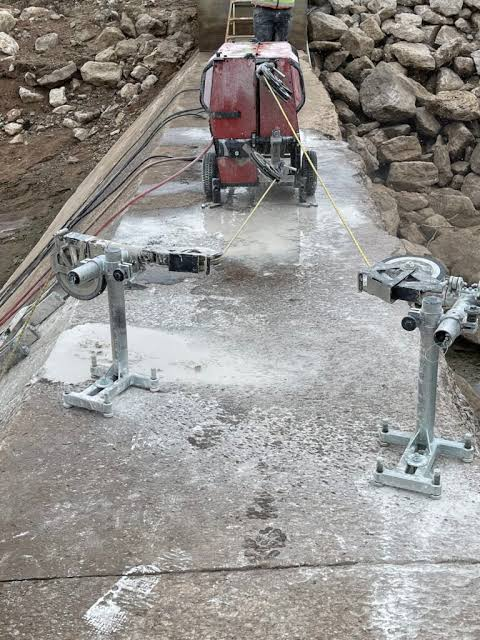
Keep everyone out of the wire plane and behind the machine, using barriers and signage. Never stand in line with the wire, especially near pulleys where snap-back happens. On urban bridge demolition and high-rise retrofitting jobs, the cutting area is usually cordoned with hard barriers and a dedicated spotter; on underwater cutting, surface boats are kept clear during wire engagement and disengagement.
3. Check Tension and Run a Low-Speed Test Pass
Run a low-speed test pass before full production and confirm the wire tracks correctly on pulleys with tension within spec for your wire diameter. This is the operator’s last chance to catch a misalignment before the wire is running at full production speed. On track-mounted wire saw machines used for wall openings and column cutting, a 30-second test pass is standard before every shift.
4. Keep Water On and PPE On
Water controls heat and dust; never run dry. Confirm water flow before engaging the cut. PPE — safety glasses, gloves, hearing protection, steel-toe boots, face protection for overhead work, and respiratory protection in confined spaces — is the minimum on every Kowis wire saw machine job. Kowis machines feature reinforced high-tensile steel wire cores and premium rubber-injected beads that reduce loose beads and snapping, but PPE is never optional.
5. Follow the Manual and Plan the Exit
Every Kowis wire saw machine ships with a manual covering setup, operation, and maintenance — train every operator on it. Know where the cut piece goes before it falls. A heavy concrete slab has enormous momentum; plan supports, slings, or drop zones in advance. Contact us for machine specs, manuals, and operator guidance.